An effective e-commerce strategy today is no longer about launching everywhere at once. It’s about proving demand, understanding consumers, and developing systems on the web before taking retail and mass-market distribution. The brands that succeed are the ones that see the internet as a proving ground, not simply an avenue for purchase.
How this strategy works best can easily be seen in the example of PepsiCo acquiring Poppi for the price of $2 billion that took place in March 2025. The story is often a major acquisition, and the truth is that the story lies in the way the e-commerce business model made this particular brand worth acquiring.
Poppi’s journey hasn’t started from a boardroom or an aisle in supermarkets. It started quietly at a farmers market in Dallas with a simple health-focused beverage. Instead of rushing into retail and hoping visibility would create demand, the brand focused on proving demand online first using direct-to-consumer sales, social media, and email marketing.
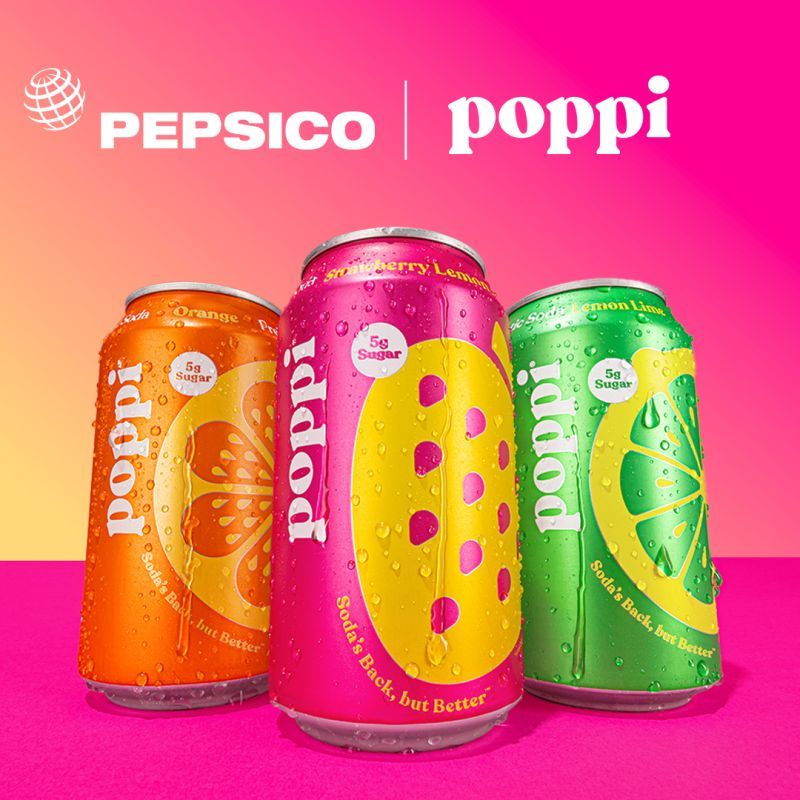
From Viral Omega’s perspective, this is one of the strongest modern digital brand case studies. It shows how a focused e-commerce strategy can validate a product, shape demand, and eventually support massive retail expansion.
The Shark Tank Turning Point
In 2018, Mother Beverage featured on Shark Tank. Rohan Oza, known for building Vitamin Water into a billion-dollar brand, chipped in $400,000. However, the capital came with clear direction.
Advice from Rohan Oza
- Rebrand the product
- Prove demand online before entering retail
That guidance reshaped the company’s future. Mother Beverage was rebranded as Poppi. The shift was significant.
- Bright, modern colors
- Aluminum cans instead of glass
- A clearer and more approachable product identity
When Poppi launched in 2019, it started online first, rather than trying to lead in the physical retail world. It marked the start of its focused e-commerce strategy, with testing, learning, and scaling based on insights.
Strategy 1: Use Online Sales as a Testing Ground
Most brands approach growth from the outside in by chasing shelf space first. Poppi did the opposite. They treated their online store as a controlled environment where every decision could be tested.
Through their e-commerce strategy, Poppi experimented with multiple variables.
What Poppi Tested Online
- Flavor performance and sell-through speed
- Messaging such as prebiotic soda versus ACV beverage
- Pricing formats including single cans versus 12 packs
- Subscription options compared to one-time purchases
- Customer demographics
What the Data Revealed
- Strawberry Lemon became the top-selling flavor
- Prebiotic soda messaging performed better than ACV-focused language
- 12 packs sold three times more than single cans
- Women aged 25 to 40 made up 70 percent of buyers
- Repeat purchase rate reached 35 percent
This data removed guesswork. Poppi knew exactly what to produce, who to target, and how to price the product. Just as importantly, they now had proof of demand backed by real orders and customer reviews.
For any brand planning future retail expansion, this type of validated e-commerce strategy changes the conversation. Poppi entered buyer meetings with evidence, not optimism.
Revenue Milestones
- End of 2019: approximately $100,000 per month
- 2020 average: $300,000 per month
- 2021: reaching $500,000 per month
Growth was steady, but the inflection point was still ahead.
Strategy 2: Founder-Led Social Content
On January 28, 2021, Allison Ellsworth put out a video on TikTok that was completely raw and unedited. There was no scripting, no cuts, no preparation.
- Her gut health struggles
- Creating Poppi in her kitchen
- Appearing on Shark Tank
- Building the business
She posted and went to sleep.
By the next morning, the impact was clear.
Results Within 48 Hours:
- 7,000 views on day one
- 50,000 likes
- 15,000 new Instagram followers overnight
- 200 percent increase in daily sales
- $180,000 in revenue in 48 hours
The company sold out of inventory and worked past midnight fulfilling orders.
This moment highlighted an important lesson. Viral attention only helps if systems are ready. Poppi’s website handled traffic, fulfillment scaled, and operations did not break. The founder narrative worked because the e-commerce strategy supporting it was already solid.
Strategy 3: Email Marketing That Builds Long-Term Revenue
By 2022, email marketing generated 30 percent of Poppi’s total revenue, exceeding $60 million annually. Most emails were not focused on selling but on educating customers and building familiarity with the brand.
Their email flows were structured and intentional.
- A welcome sequence led by the founder’s story
- Cart recovery campaigns based on timing, not immediate discounts
- Post purchase flows that encouraged repeat buying
Taken together, these systems ensured new customers were converted into loyal buyers. This component of the e-commerce strategy ran semi-automatically while generating revenue on a continuous basis.
Strategy 4: Scalable Influencer Seed Programs
Instead of relying on advertising or celebrity endorsements, Poppy turned to influencer seeding.
- Micro creators with 10,000 to 100,000 followers
- Health, wellness, and lifestyle niches
- No contracts or posting requirements
- Product sent with the option to share
This approach resulted in organic mentions from creators who genuinely liked the product. One of the most visible outcomes was Kylie Jenner sharing Poppi without a paid agreement. That moment reinforced how organic reach, when paired with the right e-commerce strategy, compounds quickly.
Why PepsiCo Paid $2 Billion
When PepsiCo acquired Poppi in March 2025, they were not just buying a beverage brand. They were acquiring a proven growth system.
- Verified online demand
- Strong repeat purchase behavior
- Owned audiences on email and social
- Scalable digital infrastructure
Poppi had already solved the hardest parts of growth before expanding aggressively into retail. That foundation made the acquisition logical.
Final Takeaway from Viral Omega
Poppi’s journey proves that an online-first approach is no longer optional for modern brands. A clear and disciplined e-commerce strategy allows companies to validate products, scale faster, and build defensible value.
The same principles apply to other consumer brands willing to test, learn, and build with data before chasing scale.
Poppi started at a farmers market and became a $2 billion brand by getting the fundamentals right online.
Validating demand online, testing products through direct-to-consumer sales, using founder-led content, building email-driven repeat purchases, and scaling awareness through organic influencer seeding.
Poppi is a strong example, using online sales to prove demand, scale revenue, build repeat customers, and attract a $2 billion acquisition.
Testing before scaling, founder-led storytelling, email-driven retention, and organic influencer reach supported by strong e-commerce infrastructure.