Marketing language can get confusing quickly. You hear about digital marketing, paid campaigns, or data-driven growth, but one term keeps coming up again and again: performance marketing.
This blog breaks the idea down in a simple, practical way. We will talk about what it really means, why businesses are so focused on it today, and how you can actually measure whether it is working. No jargon. No theory-heavy definitions. Just clear explanations backed by real marketing practice.
All marketing wants to perform, so why a separate term at all
Here is a simple truth. No one spends money on marketing hoping it fails. Campaigns exist because we want results. In that sense, every ad, every post and every email is trying to perform in some way.
So why does this one phrase exist at all? Because in everyday use, people use it to describe a very specific style of working. It is not just about advertising. It is about linking money spent to visible outcomes and then making decisions based on those outcomes.
Think of sports. Athletes always try to perform. But when bonuses depend on scoring, the connection between performance and reward becomes very direct. The same idea applies here in the marketing world.
What is Performance Marketing?
Here is the core idea: Performance marketing usually refers to marketing where payment is connected directly to measurable actions. For example:
- a click on a search ad
- a thousand impressions on a social platform
- a sign up or completed form in some campaigns
The focus is on trackable behavior, not just exposure. People sometimes debate which actions should count. Some say impressions are too soft. Others say only purchases matter. Those debates exist, but the shared foundation is measurement and accountability.
With performance marketing
- you choose clear goals
- you track what happens
- you learn from results
- you adjust based on evidence
This is what turns marketing from guesswork into a system you can improve week by week.
Difference between Performance Marketing and Traditional marketing
Not every activity fits naturally into this category. Things such as:
- building brand reputation
- long-term content creation
- event marketing
- public relations
- search engine optimization
are valuable but are usually paid for before you clearly see the result. They compound over time, influence trust, and shape perception, but it is harder to tie one single spend to one single action.
Paid online channels, on the other hand, make measuring easier. You can see clicks, conversions, and costs more or less in real time. That is why people often associate this style of marketing with paid ads.
Why Performance Marketing grows Businesses faster
With performace marketing you no longer argue about opinions. You look at numbers. You can:
- stop campaigns that waste money
- scale campaigns that actually work
- experiment safely with new ideas
- predict results with more confidence
You change a headline, a visual, an audience, or a landing page, and you quickly see what happened. That feedback loop is what accelerates learning.
KPIs for Business Growth
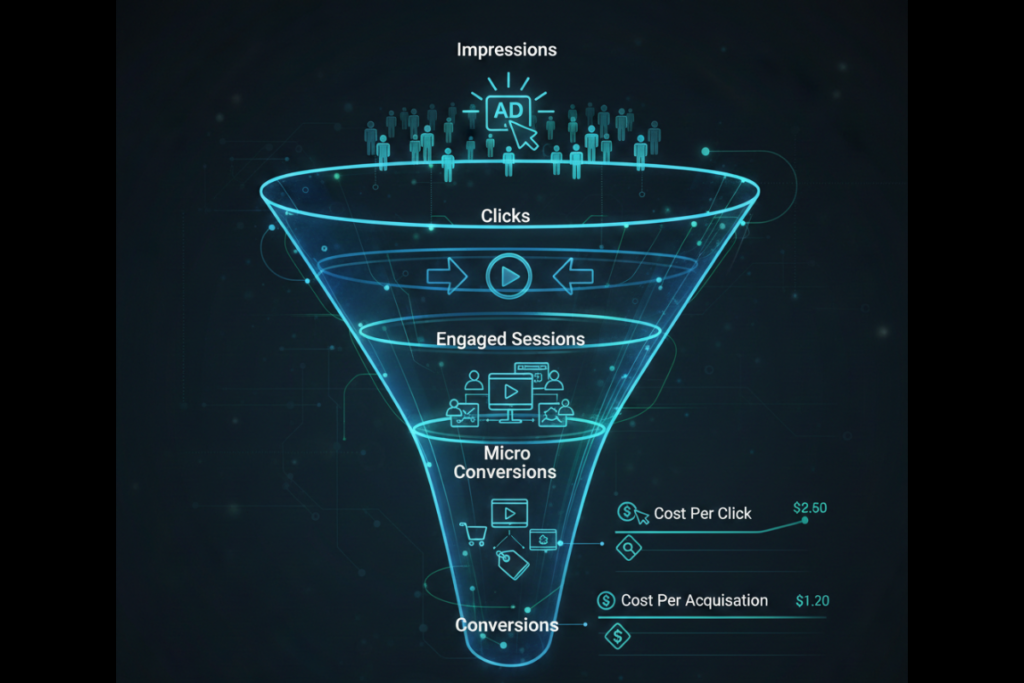
Here is where it becomes practical. If you want to work with this approach, there are some numbers you should get comfortable with.
Start with the top of the funnel:
- Impressions: How often your ad was shown to people.
- Clicks: How often someone acted and decided to visit or engage.
Then look a little deeper:
- Engaged sessions: These are people who spent some time, viewed more than one page, or triggered an important event. This helps you see if your page actually delivers on what the ad promised.
- Micro conversions: These are smaller but meaningful steps such as checking pricing, adding to cart, watching a video, or using the search bar on your site.
Then the main outcome:
- Conversions: This is the primary goal such as purchase, booking, signup, or lead form completion.
Now connect this to cost:
- Cost per click: Helps you understand how expensive traffic is for different campaigns and audiences.
- Cost per acquisition: Shows whether the money you spend to get each customer is sustainable for your business.
A key mindset shift happens here. It is no longer about whether a campaign looks nice. It is about whether it moves numbers that matter to revenue and profitability.
Founder-Focused metrics
When you share reports with leadership, the conversation usually moves toward bigger picture metrics such as:
- return on ad spend
- marketing efficiency ratio
- lifetime value of a customer
- cost of acquiring a first time buyer versus repeat buyer
These metrics help answer questions like:
- Are we paying too much to win customers
- Should we spend more on one channel and less on another
- Which customers are actually profitable over time
For example, if someone who spends more on their first order stays longer and spends more over their lifetime, you might be willing to pay more to acquire them compared to bargain seekers. That is a smart use of performance marketing thinking applied to real strategy.
How to get started with this approach step by step
Here is a simple starter checklist:
- decide exactly what action matters most to your business
- set up proper tracking before spending anything
- write down target numbers instead of guessing
- start small and test creatives and audiences
- review results consistently instead of occasionally
This approach removes luck from the process and replaces it with learning.
Conclusion
When you advertise smarter, you spend with intention, and you give yourself room to improve over time instead of relying on one lucky campaign.
That is the real strength of performance marketing in the modern digital environment. It is not just another buzzword. It is a practical way of running marketing that connects activity directly to business results.
If you want help setting up systems, understanding your numbers, or improving existing campaigns, this is exactly the type of work we do at Viral Omega.
Growth accelerates because decisions rely on data, not guesses. You measure actions, stop wasteful campaigns, improve steps in the funnel, and invest more in what converts, creating learning and revenue.
Common examples include search ads, social ads, affiliate programs, and campaigns where you pay per click, impression, lead, or sale. The emphasis is on measurable actions and optimizing spend conversions.
Important KPIs include impressions, clicks, engaged sessions, micro conversions, conversions, cost per click, and cost per acquisition. These metrics show visibility, interest, efficiency, and whether customer acquisition is financially sustainable.
Traditional marketing often emphasizes term brand building and pays upfront without precise attribution. Performance marketing focuses on measurable actions, tracking, and optimizing spend toward conversions that link to business outcomes.