
Valentine’s Day is one of the biggest shopping moments of the year. In fact, outside of Christmas and Mother’s Day, it consistently ranks as one of the highest-spending occasions globally. For e-commerce sellers and print-on-demand brands, this makes it a non-negotiable season to plan for early.
TThis guide breaks down what’s working as we head into Valentine’s Day 2026, how consumer behavior is shifting, and how you can still turn these insights into products that sell. These Valentine’s Day marketing strategies are designed for print-on-demand vendors looking to gain quick traction.
If there’s one thing you should know right away, it’s that late January is not too late, but it’s the time when execution counts most. As Valentine’s Day draws near, buyers are actively perusing, platforms are giving seasonal relevance top priority, and momentum builds rapidly.
Why timing matters for Valentine’s Day campaigns
Search and sales data show that interest in Valentine’s Day peaks sharply from late January through early February. That means listings optimized and updated now aren’t behind, they’re entering the highest-intent window. This is particularly true on sites like Shopify and Etsy, where visibility is accelerated by seasonal relevance and engagement.
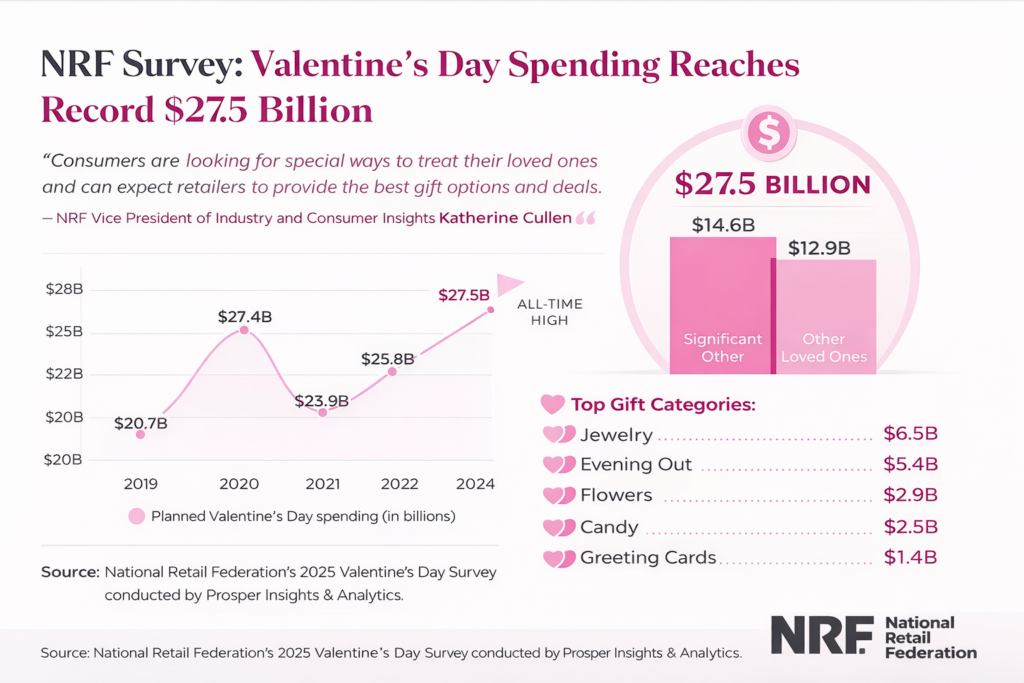
Consumer spending proves why this matters. According to National Retail Federation data, shoppers spent over $27.5 billion on Valentine’s Day last year, with expectations of continued growth. That spend is already in motion. It’s happening through discovery, comparison, and personalization right now.
For print-on-demand sellers, Valentine’s Day campaigns at this stage are less about planning and more about positioning: refining listings, updating SEO, highlighting personalization, and making sure the right products are visible while buyer intent is at its highest.
Valentine’s Day marketing strategy
Access to free trend data is one of the benefits that small brands tend to overlook. Seasonal reports on what boutiques are actively purchasing to stock their shelves are published by wholesale platforms such as Faire. That is potent because it shows actual purchase intent rather than merely inspiration.
Consumers look for personalized, sentimental, and thoughtful products. The emotional motivations of jewelry definitely translate to print-on-demand, even though the jewelry itself might not.
Customization is the core advantage of print-on-demand. Products that can be personalized on demand, like names, dates, locations and inside jokes, that naturally align with strong Valentine’s Day marketing ideas.
Greeting Cards and Snail Mail are Rising Again
Physical greeting cards are becoming more and more popular every year, despite the predominance of digital communication. Handwritten, tangible experiences are becoming more and more valued by consumers, particularly on sentimental occasions.
For print-on-demand vendors, this makes greeting cards one of the easiest Valentine’s Day marketing strategies. They are lightweight, adaptable, simple to test, and appealing to all age groups.
The contrast in tone is particularly intriguing:
- Pop culture, irony, and humor appeal to younger audiences.
- Sentimental and heartfelt messaging is still preferred by older demographics.
Both work, but the key is offering options and letting the customer choose.
Expanding beyond couples with Valentine’s Day gift ideas
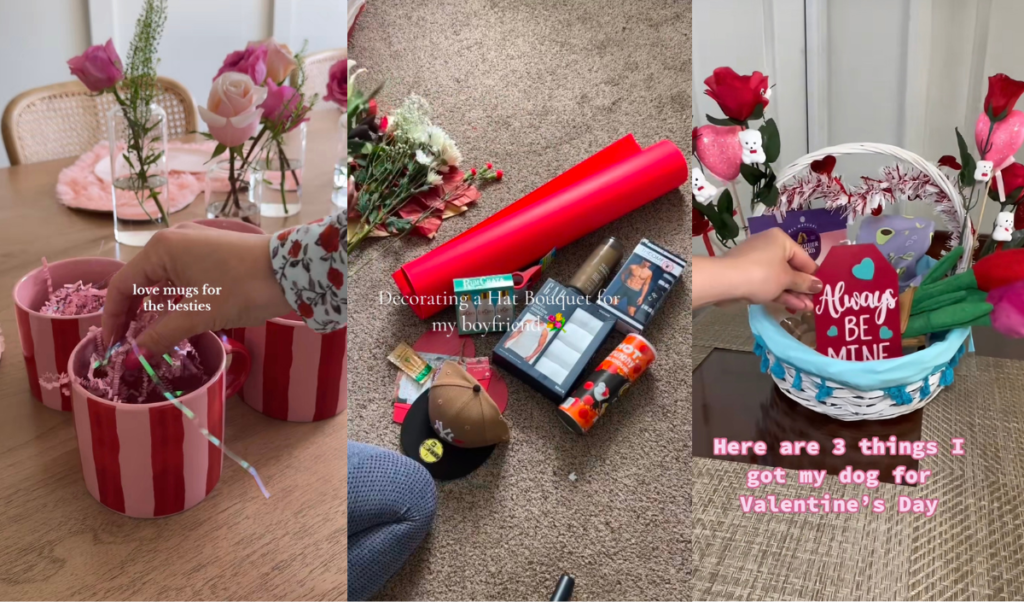
Valentine’s Day has expanded beyond romantic partners. Nowadays, an increasing proportion of consumers purchase goods for themselves, friends, coworkers, and kids. More than one-third of buyers intend to buy presents just for their friends.
This shift opens up massive opportunity for sellers willing to niche down:
- Galentine’s Day gifts for best friends
- Office-safe coworker items
- Long-distance friendship keepsakes
This is where Valentine’s Day marketing ideas become more creative and less competitive. Instead of fighting over saturated couple designs, sellers can target overlooked relationship types with highly specific personalization.
Validating Products Using Etsy Sales Data
Trend predictions are powerful, but validation comes from sales history. Tools that analyze Etsy performance show clear patterns of what worked last year and why.
The following characteristics are shared by some of the top performers:
- Customization connected to a common memory (first date, proposal, first place together)
- Simple designs that feel emotional, not overdesigned
- Products that extend beyond Valentine’s Day into other gifting seasons
Wall art that depicts places, dates, or significant events usually works well. In their first year of business, many of these listings bring in tens of thousands of dollars, demonstrating the superiority of evergreen emotional products over novelty items.
These insights aid in improving Valentine’s Day promotions so they are based on tested consumer psychology rather than conjecture.
Apparel and High-Ticket Items are Driving Valentine’s Day Sales
Another misconception in print-on-demand is price ceilings. Valentine’s Day shoppers are spending far more than $20 on blankets, embroidered clothing, and personalized décor.
Examples include:
- Personalized crewnecks for best friends
- Humor-driven blankets with custom names
- Minimalist apparel with subtle emotional cues
Many of these products also perform outside February, making them ideal for sellers who want to maximize lifetime value. Smart Valentine’s Day sales don’t rely solely on discounts. They rely on perceived meaning.
Simplicity beats Complexity In Product Design
One of the strongest patterns across top-selling listings is design restraint. Products that sell hundreds of units often feature:
- Clean typography
- Neutral color palettes
- Minimal graphic elements
This is important for print-on-demand sellers who assume complexity equals value. In reality, emotional clarity matters more than visual noise. Simple products convert because they allow the buyer to project their own meaning onto the item.
That principle applies across all Valentine’s Day marketing ideas aimed at long-term success.
AI-Powered Personalization Scaling Without Friction
Offering customized design aesthetics without sophisticated design knowledge is now simpler than ever thanks to new tools. In just a few minutes, sellers can transform client photos into watercolor, sketch, or illustrated styles thanks to image-editing AI.
This unlocks new product categories:
- Watercolor mugs from first-date photos
- Illustrated wall art from proposal locations
- Custom gifts that feel handmade but scale digitally
This process shortens production times while boosting perceived value when combined with platforms like Canva and print-on-demand providers, which benefits margins and customer satisfaction.
Turning Research Into Execution
The biggest takeaway is this: Valentine’s Day success is built months before February 14. Sellers who research early, validate with data, and launch intentionally are the ones who win.
That’s the same approach we take when building seasonal growth strategies at Viral Omega. We combine real consumer behavior with execution frameworks that scale.
There is a clear opportunity for 2026. Valentine’s Day marketing ideas can be one of the most lucrative growth levers for a print-on-demand company all year long with the correct timing, positioning, and personalization.
Market Valentine’s Day by launching early, using personalization, validating products with real sales data, and focusing on emotional, thoughtful, and sentimental products that align with proven seasonal buying behavior.
The target market includes partners, friends, coworkers, long-distance relationships, and self-gifters, as Valentine’s Day shopping has expanded beyond traditional romantic relationships.
Companies create Valentine’s promos by using personalization, niche targeting, emotional messaging, and products that feel thoughtful rather than relying only on discounts.
Valentine’s Day drives massive spending, peaks in January searches, includes non-romantic gifting, favors personalization, and rewards early product launches over last-minute listings.